Research
The Engineering and Design Core Facility (EDCF) serves faculty, staff, and student researchers across multiple disciplines. See highlights of research projects the facility has supported below:
DEIMOS
University of Notre Dame and Caltech Optical Observatories
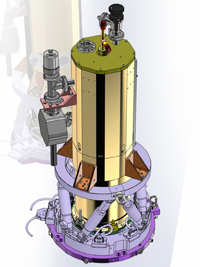
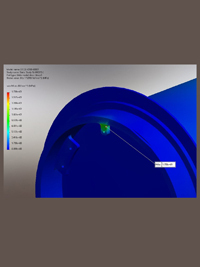
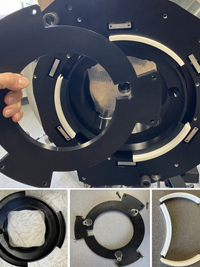
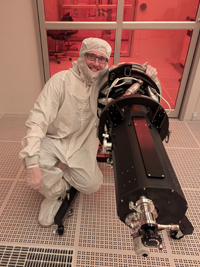
As the most versatile instrument at Keck II Observatory, DEIMOS has contributed to nearly 1,000 refereed publications. Notre Dame collaborated with Caltech to replace the cryostat, modernize the flexure compensation system, and upgrade the detectors and electronics to maintain state-of-the-art quantum efficiency.
Skills: Mechanical, Electrical
Mach 6 Wind Tunnel
University of Notre Dame and the Air Force Office of Scientific Research (AFOSR)
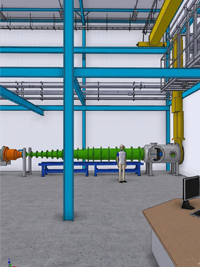
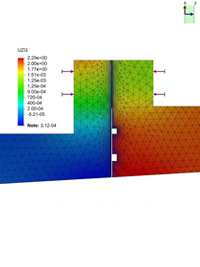
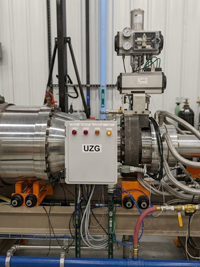
Notre Dame helped develop the Large Mach 6 Quiet Hypersonic Wind Tunnel with the Air Force Office for Scientific Research to advance the science of hypersonic vehicles. The EDCF created the detailed mechanical design of the converging/diverging nozzle assembly.
Skills: Mechanical

Thermal Grill
University of Notre Dame Researchers
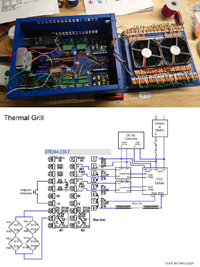
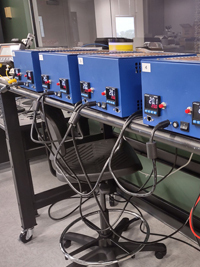
The Thermal Grill device was built for the Psychology department to demonstrate a sensory illusion. The device regulates the temperature of alternating copper bars. When all bars are at 20ºC, they feel cool. When all bars are at 40ºC, they feel warm. For some people, when the temperatures of the bars are interlaced at 20ºC and 40ºC, they feel pain. Temperatures that normally feel warm or cool feel painful when the temperature of the bars is alternating. The EDCF provided the simplified, standalone design, and prototyped four of the devices.
Skills: Mechanical, Electrical


Solenoid Spectrometer for Nuclear Astrophysics and Decays (SSNAPD)
University of Notre Dame and the National Science Foundation
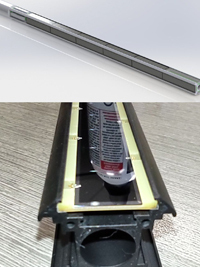
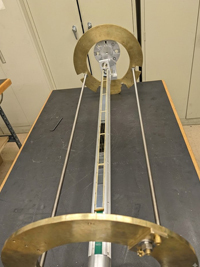
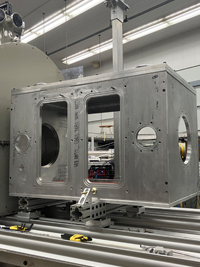
Designed to conduct nearly background-free evaluations of branching ratios for particle decay, SSNAPD is a novel charged-particle detector array. Notre Dame developed this system using segmented silicon strip detectors within a large-bore solenoid magnetic field to prioritize the detection of low-energy particles for research into explosive nucleosynthesis.
Skills: Mechanical, Electrical

Nonlinear-Curvature Wavefront Sensor
University of Notre Dame Researchers
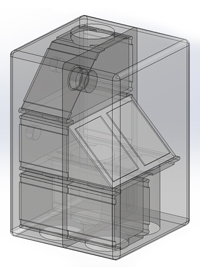
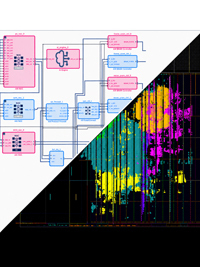
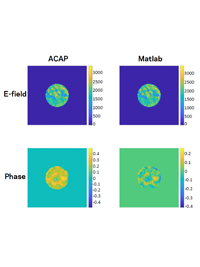
To mitigate the light wave distortion caused by Earth’s atmosphere, Notre Dame is developing a novel sensor that excels in highly turbulent environments. The EDCF provided optomechanical design and real-time computing support to reduce the system's physical footprint and enhance phase retrieval speeds for high-frequency operations exceeding 1kHz.
Skills: Electrical, Software, Optical

iLocater
University of Notre Dame
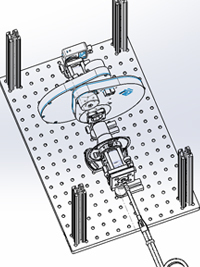
As a pioneering extreme-precision radial velocity instrument, iLocater aims to identify Earth-sized exoplanets using an infrared spectrograph and a specialized acquisition camera at the Large Binocular Observatory. The EDCF provided comprehensive support across the project's development cycle, delivering critical mechanical, electrical, and software engineering expertise to ensure the system achieves sub-milli-Kelvin cryogenic stability.
Skills: Mechanical, Electrical, Software


Gemini Planet Imager (GPI2.0)
University of Notre Dame and the Gemini Observatory
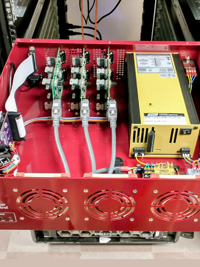
As a facility-class instrument optimized for the direct imaging and spectroscopic characterization of Jupiter-mass exoplanets, GPI is undergoing a significant relocation and modernization. Notre Dame is collaborating with multiple institutions on the GPI2.0 upgrade to integrate new scientific capabilities at Gemini North. The EDCF is providing critical mechanical, electrical, and systems engineering support to facilitate this complex instrumentation overhaul.
Skills: Mechanical, Electrical, Software, Optical

EMPHATIC Positioning Table
University of Notre Dame and Fermi National Accelerator Laboratory
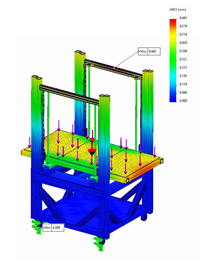
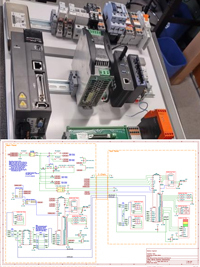
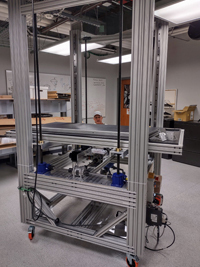
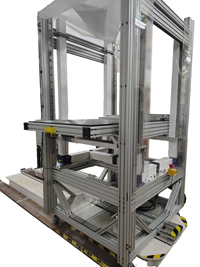
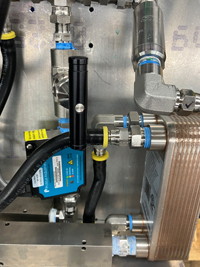
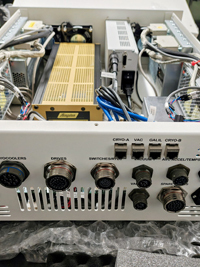
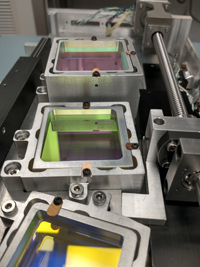
To enable critical nuclear interaction measurements for Phase 2 of the EMPHATIC neutrino experiment, the University of Notre Dame designed and engineered a custom, 800-pound precision motion table capable of accurately translating a small-aperture spectrometer across the face of a particle focusing horn. Notre Dame’s modular 80/20 aluminum construct is divided into four integrated assemblies—platform, lifting, base, and floor—and utilizes a dual-servo motor system to drive precise two-axis movement via four coordinated vertical screw jacks and floor-mounted horizontal V-groove rails. Featuring customizable threaded aluminum breadboards for flexible component layout alongside integrated polycarbonate safety guards, this Notre Dame-developed apparatus provides the rigid stability and fine position control required to capture first-ever measurements of charged particles exiting the horn.
Skills: Mechanical, Electrical